
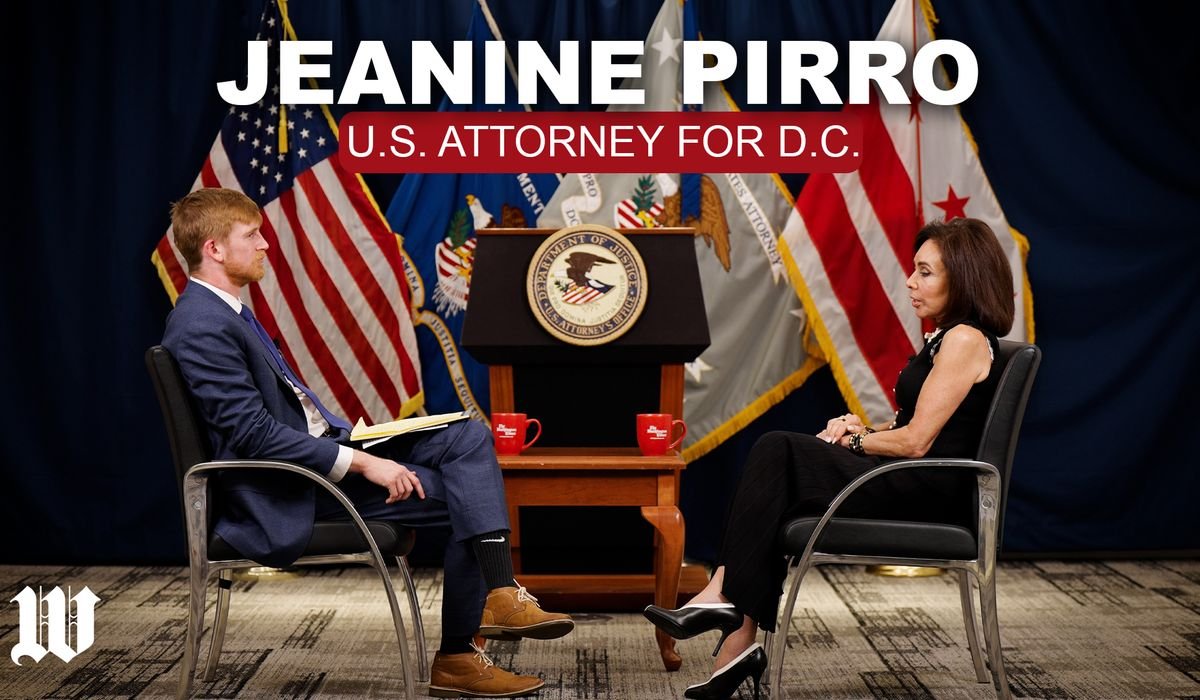
With the Fourth of July approaching and political violence on the rise, U.S. Attorney Jeanine Pirro sits down with Matt Delaney to break down how Washington went from one of the worst prosecution rates in the country to one of its most aggressive, what that means for public safety in the nation’s capital, and how D.C. is preparing for Fourth of July celebrations.
[DELANEY] Three years ago, this office did not pursue charges in two-thirds of the cases that were brought to it by the Metropolitan Police Department. Now, according to the DOJ’s annual report — I know you’ve got some updated statistics — but to what we could get publicly available, that number has dropped to only 19% of the cases that are not being presented in D.C. Superior Court. How do you explain that turnaround?
[PIRRO] Well, I think the turnaround is even greater than what you say. And I think the sad part of this is that for a period of time, the residents of the District of Columbia were not being served very well by an office that was refusing to paper 67% of arrests made by law enforcement in the district. That is a real insult to the safety and security of people in the District. My understanding is that at that point, Congress itself got involved because of the concern. And it was at that point that violent crime was extremely high. D.C. had the fourth-highest homicide rate in the country.
And so I’m very proud of the numbers that you referenced, 19%. But that really is not the true story. Those numbers are over a year old. Since August of 2025 and the surge, the numbers have gone down to 4% of the cases that are not being papered.
So I think it’s a combination of our recognizing that when police make an arrest, it’s our obligation to look at those cases and request more information if necessary so that we can go forward with criminal charges, or to continue the investigation, or at least to let the police know this is what we need. And once we started doing the police training and had them recognize what we need in order to go forward with a case, we’re at the point now where it’s only 4% of the cases that we are refusing to paper. And I think that’s good news for the people of the District.
And it really reflects what President Trump has said. He wants to make D.C. safe and beautiful as well. Beautiful, you know, kind of is a tag for us as prosecutors. But it really is a reflection of the broken windows theory — that, you know, the more the even the lower level crimes are being prosecuted, the more people recognize that the laws are being followed, that, you know, vandalism isn’t being tolerated, and the safer people are in the long haul.
[DELANEY] What did you need from police specifically for them to gather better evidence, to present better evidence to you guys in your office?
[PIRRO] Well, no, I certainly am not in a position to criticize the police. In fact, the police were making arrests in spite of the fact that the result was, no, we’re not going to prosecute the cases, by the other U.S. attorneys.
For me, it was doing training for the police. This is a very large office. We have a lot of prosecutors. We have a training division. We have the Metropolitan Police Department, that is a great police department. We train them. We train the Capitol Police and the Park Police and the Marshals. And I do training with the Marshals, with the FBI. It’s our obligation to let them know what we need and what the courts are doing, because regularly the courts change in their interpretation of the law, and it’s important for law enforcement to know what the courts are seeing as appropriate or not appropriate.
So 4% is really a combination of police training, but also a prosecutor and an administration that realizes that it is important to protect people. And in order to protect people, we have to prosecute bad people. I take the side of the victim. Criminals belong behind bars if they’re violent criminals, and our job is to protect the citizens. And that is the first obligation of government, and I think that those numbers make it clear that that’s just what we’re doing.
[DELANEY] Sticking on the topic of training, your predecessor mentioned that it was hard to secure convictions for gun possession, some low-level drug offenses and misdemeanors. Was that a problem of prosecutor training, that they just didn’t know how to responsibly present those cases in court?
[PIRRO] Well, I can’t compare, you know, a not guilty verdict with maybe they didn’t have enough training. You know, I’m not a statistician. But what I can tell you is that training is essential. You know, we’ve got the D.C. Court of Appeals, which in many cases is far more restrictive of police conduct than even the United States Supreme Court. So there are things, especially when we bring officers from other jurisdictions, other federal law enforcement agencies who are used to doing things a certain way, where the D.C. Court of Appeals says, no, even though the Supreme Court allows that, we’re not going to allow that in D.C. So I have to continue to train and bring them up to date on where they are.
But I think that going back to 4% — I think that really is a certain respect for the crime victim. It is respect for law enforcement that goes out there and puts together cases. It is a collaborative effort where we say we need maybe a little more to bring the charges, but we bring the charges. Then it’s up to us to try to convince a jury. A jury may not be convinced, and so be it. That’s the way the system works.
