
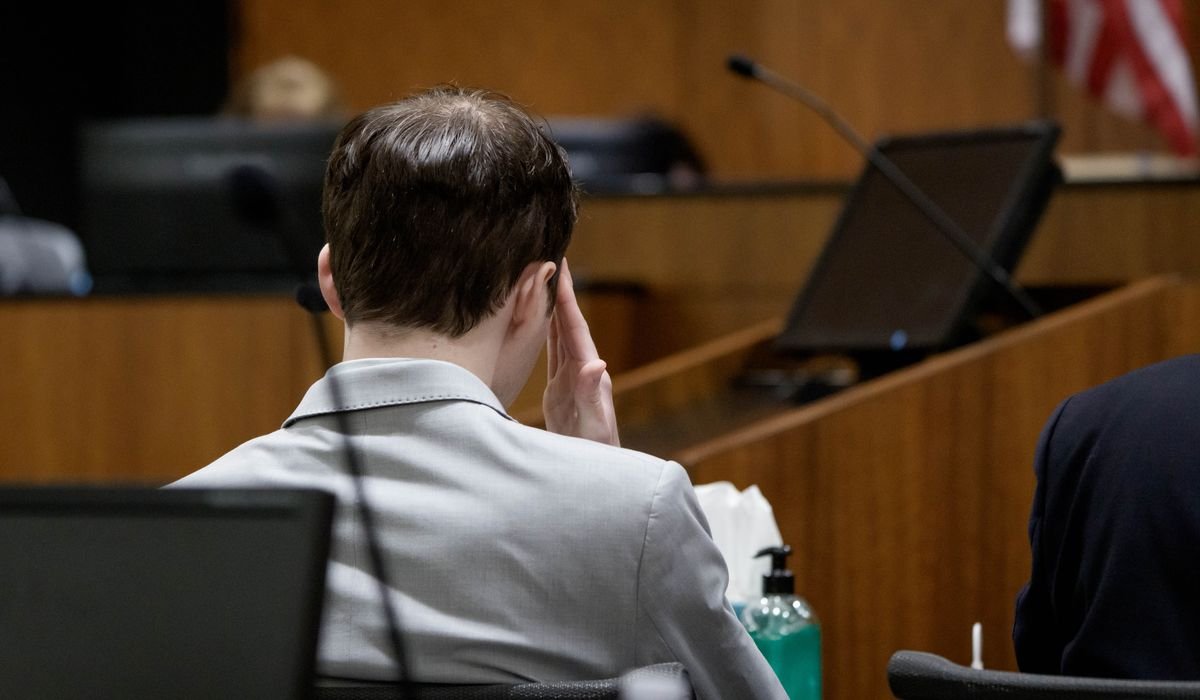
Tyler Robinson, who Utah prosecutors say assassinated Turning Point USA co-founder Charlie Kirk, returned to his apartment after the shooting and told his roommate and romantic partner he “wished he hadn’t done it.”
He also confessed in a hand-written note, which prosecutors briefly displayed in court, that he left his St. George, Utah, apartment early on the morning of Sept. 10 “on a mission,” and that he “had the opportunity to take out Charlie Kirk,” and “took it.”
Mr. Robinson is charged with aggravated murder and faces the death penalty. He has not entered a plea as prosecutors presented part of their case in this week’s preliminary hearing.
Judge Tony Graf will determine whether there is enough evidence to move forward with a trial.
Prosecutors have presented video, DNA and physical evidence that they say link Mr. Robinson to the shooting of Kirk while he held an outdoor event with students at Utah Valley University.
Lance Twiggs, Mr. Robinson’s boyfriend, offered key witness testimony on Thursday.
A day after Kirk’s murder, Mr. Robinson returned to the apartment he shared Mr. Twiggs, who testified in a pre-taped video shown in court that there were tears and pacing back and forth as the two talked about what happened.
Mr. Twiggs, who said he was dating Mr. Robinson at the time, said Mr. Robinson “didn’t go into detail” about the shooting.
“I just asked him in person if what he said was true the night before, and he said it was,” Mr. Twiggs said, referring to Mr. Robinson’s confession to him in a text sent around 11 p.m. on Sept. 10.
“He started crying a little bit and said he wished he hadn’t done it, and then kept going around and just doing stuff — I think to keep himself busy or distracted or something,” Mr. Twiggs testified.
Mr. Robinson then discussed what to do next. He said he would “talk to his parents or turn himself over,” Mr. Twiggs recalled.
Kirk was killed by a single bullet fired at him from a rooftop while he engaged with students under a tent on the campus. Prosecutors this week presented video surveillance footage they say tracks Mr. Robinson walking around the campus and positioned on the roof at the time of the shooting.
Mr. Twiggs’ voice was heard for the first time since he was named as Mr. Robinson’s roommate and boyfriend at the time of the shooting.
In the video interview with Utah County prosecutor Ryan McBride, recorded on April 20, Mr. Twiggs was dressed in a suit and tie and wore his hair past his shoulders. He was asked to spit out chewing gum.
Mr. Twiggs was provided with limited immunity in the case. The videotaped testimony was played a few feet away from where Mr. Robinson was seated in the courtroom next to his defense attorneys.
Brian Davis, an agent with the Utah State Bureau of Investigation, testified about the text message confession, much of which was released to the public months ago.
In the Sept. 10 text shown in the courtroom, Mr. Twiggs asked Mr. Robinson, “you weren’t the one who did it, right????” Mr. Robinson texted back, “I am, I’m sorry.”
Mr. Robinson was texting from near the Utah Valley University campus as he plotted how to retrieve his rifle, which he had discarded in a wooded area after the shooting.
The two discussed via text message why Mr. Robinson left the rifle behind and how he could replace the gun so his grandfather, who owned it, wouldn’t notice it missing. Mr. Robinson texted about the messages he engraved a month earlier into the bullets, which he described as “a big Meme.”
Mr. Robinson texted the rifle did “just fine” shooting at a distance, referencing the gun’s intended use in family deer hunting.
He eventually gave up trying to retrieve the gun due to police presence in the area. He drove back to the St. George apartment he shared with Mr. Twiggs.
Police found the weapon and prosecutors showed a photo of the rifle in court, along with bullets engraved with various messages, including “hey fascist catch.”
Prosecutors presented DNA evidence linking Mr. Robinson to the weapon and the ammunition as well as a Dremel tool used to carve the messages in the bullets.
According to Mr. Twiggs, Mr. Robinson engraved the bullets about a month before Kirk’s assassination. Mr. Robinson told him at the time he planned to use the bullets in a hunting trip with his family.
Authorities found an addition carved bullet in Mr. Robinson’s apartment with the message, “Test Bullet.”
Mr. Robinson turned himself in to authorities on Sept. 11, accompanied by his parents and a family friend.
In a final message to Mr. Twiggs, he texted, “if any police ask you questions ask for a lawyer and stay silent,” adding that he’d ask his own lawyer to reach out to Mr. Twiggs.
Mr. Twiggs, in the video testimony, said Mr. Robinson liked to talk politics but he never heard him mention Kirk.
The defense team presented jarring photos of the bullet fragments recovered from the shooting and grilled an analyst with the Bureau Alcohol Tobacco Firearms and Explosives about its inconclusive results when trying to match the fragments to the recovered weapon.
“I’m unable to say one way or another,” ATF bullet analyst Samantha Carner said, noting a lack of microscopic marks needed to make the analysis.
Gun experts say it’s a typical finding because the bullet broke into small pieces.
The taped interview with Mr. Twiggs and the text messages were presented after days of legal wrangling among the defense, prosecutors, the media’s lawyers and Kirk’s widow, Erika Kirk.
The defense successfully fought to keep from the public some testimony from Brian Davis, an agent with the Utah State Bureau of Investigation, who testified about the text message confession, much of which was released to the public months ago.
Also kept out of the preliminary hearing were some unreleased text messages and certain testimony from Mr. Twiggs, arguing they would taint the future jury pool and jeopardize Mr. Robinson’s right to a fair trial.
Ms. Kirk’s lawyer, Jeffrey Neiman, argued all the evidence in the preliminary hearing should be public.
“This has not been easy, as you can imagine, and I think the family deserves to see the evidence that’s been gathered in this investigation,” Mr. Neiman said. “They deserve to know what happened to Charlie.”
